

When air pollution is high, especially during winter, most people spend much of the day indoors to avoid it. But it’s important to be aware that indoor air quality is not always good. It can contain pollutants that are invisible to the naked eye. These include dust, pollen, pet dander, mould spores and fine particulate matter.
These particles can enter your home and impact your overall comfort level, particularly in closed spaces with little ventilation. As awareness of indoor air quality increases, many homes are choosing HEPA air purifiers to aid in keeping the air cleaner.
This guide will explain what a HEPA air purifier is and how it works.
What Does HEPA Stand For?
HEPA stands for High-Efficiency Particulate Air. It is a type of filter that is designed to capture at least 99.97% of airborne particles of a size of around 0.3 microns. These HEPA filters were originally used in environments that required very high levels of cleanliness. However, they are now commonly used in home air purifiers because they help reduce dust, allergens, and other particles that can affect indoor air quality.
How Does a HEPA Filter Work? (The Science Behind the Filtration)
HEPA filter is made up of a dense network of fine fibres, arranged in different directions. As air passes through the HEPA filter, this dense network of fibres traps contaminants in different ways. Large particles are caught directly, while finer particles stick to the fibres as they make their way through the filter.
This continuous process helps in removing airborne pollutants from the room and circulating cleaner air back into your living space.
What Can a HEPA Air Purifier Remove from the Air?
HEPA air purifiers can effectively capture some of the commonly found airborne particles indoors, including:
- Dust and dust mites
- Pollen and other allergens
- Pet hair and pet dander
- Mould spores
- Fine particulate matter (PM2.5)
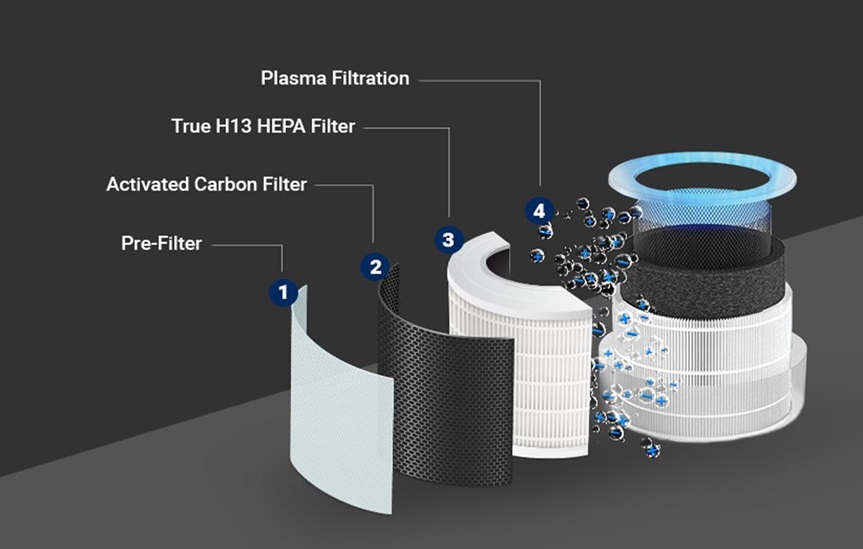
Many modern air purifier models include prefilters (which trap visible dust particles like hair) and activated carbon filters, which help reduce unpleasant odours and some gases that HEPA filters alone cannot capture.
True HEPA vs HEPA-Like: Understanding the Difference
Not all filters labelled “HEPA” can provide the same level of air purification. A True HEPA filter is tested to capture at least 99.97% of particles measuring 0.3 microns, meaning it is highly effective at removing fine airborne contaminants such as particulate matter (PM 2.5).
HEPA-like filters, on the other hand, do not necessarily follow the same stringent standards. Though they can capture larger particles, their filtration efficiency generally varies from model to model.
HEPA Ratings Explained: What Do H10, H11, H13, and H14 Mean?
HEPA filters are available in different grades based on how well they capture particles.
- H10 filters capture around 85% of particles.
- H11 filters capture approximately 95%.
- H13 filters capture 99.95% of particles and are commonly used in premium home air purifiers.
- H14 filters capture up to 99.995% of particles and are generally used in hospitals.
For most homes, an H13 filter offers an excellent balance between performance and practicality.
Advantages of Using a HEPA Air Purifier at Home
There are certain advantages associated with using a HEPA air purifier at home:
1. Helps in removing common allergens such as dust and pollen from the air.
2. Reduces fine dust and PM2.5 particles by trapping them within its layers of fibres.
3. HEPA air purifier traps allergen triggers like dust, pollen and pet dander, making it suitable for homes with allergy patients.
4. HEPA air purifiers often come with multi-stage filtration, consisting of an activated carbon filter. It reduces smoke and unpleasant odours.
How Often Should HEPA Filters Be Changed?
HEPA filters become clogged due to the accumulation of dust particles with time, which gradually may reduce their effectiveness.
Generally, most manufacturers suggest that they should be changed every six to twelve months. But depending upon other parameters like frequency of use, level of pollution, and presence of pets in the house, the frequency of filter replacement may vary.
Conclusion
A HEPA air purifier helps in maintaining cleaner indoor air by removing a wide range of airborne particles that commonly accumulate inside homes. Knowing the difference between True HEPA and HEPA-like filters along with how the filtration process works can help you make an informed decision when choosing an air purifier. Cleaner air supports everyday comfort.

Comments are closed.