

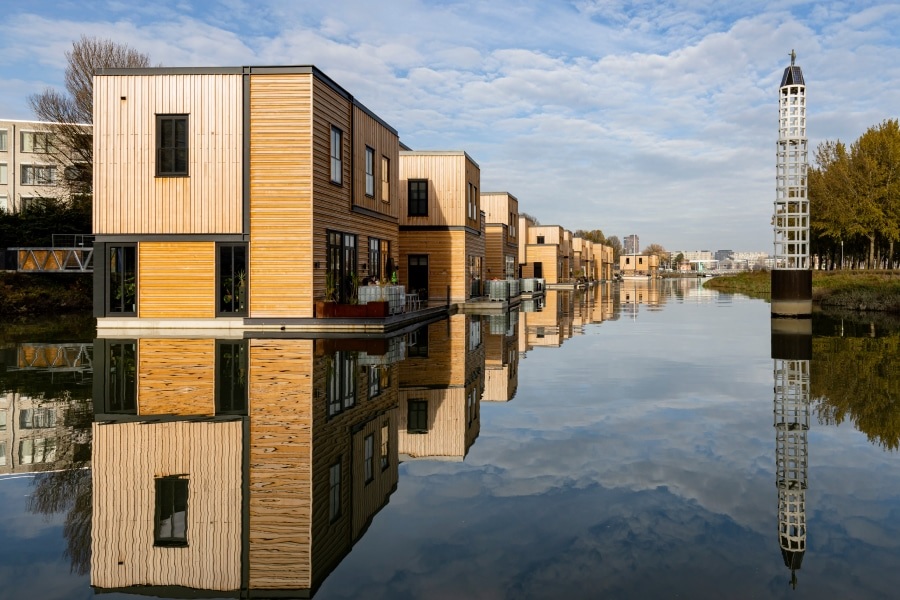
Waterfront cities across the United States and around the world sit at an awkward crossroads. Demand for coastal and riverfront housing keeps climbing, yet rising sea levels, heavier rain events, and aging seawalls make traditional ground-level construction riskier by the decade. Building higher levees or retreating miles inland solves part of the problem, but neither option fits every harbor, bayou, or delta.
Floating architecture offers a different way forward. Instead of fighting water with rigid walls that eventually give way, floating and amphibious buildings rise and fall with the surface beneath them. What once looked like sci-fi renderings or quirky houseboats is steadily maturing into practical urban design that can expand usable space, support resilient neighborhoods, and keep coastal economies moving.
How Floating and Amphibious Buildings Actually Work
People often lump all water-based buildings together, though the engineering behind them splits into distinct approaches. Full floating structures rest permanently on buoyant hulls or pontoons—commonly reinforced marine concrete or foam-filled composite platforms—and stay anchored to the basin floor or guide pilings so they can adjust to tides and seasonal water shifts without drifting away.
Amphibious architecture takes a hybrid path that has gained strong traction in flood-prone regions. Under normal conditions, an amphibious home sits firmly on the ground or low pilings just like a conventional house. When floodwaters rise, buoyancy blocks beneath the structure displace water while vertical guideposts keep the building aligned as it lifts upward. Once the water recedes, the structure settles back into place with minimal cleanup.
Utilities That Move With the Water
A building cannot float in isolation if the people inside still expect hot showers, reliable power, and clean wastewater disposal. Modern floating neighborhoods solve this with flexible or self-sealing utility connections, coiled lines that stretch as water levels change, and localized systems. Many waterborne projects pair solar panels and heat pumps with decentralized water treatment or closed-loop waste systems so a single severed municipal pipe does not knock an entire block offline.
Real-World Lessons From Waterborne Neighborhoods
The most useful proof of concept is not a giant offshore megacity drifting into open ocean. It is the smaller, grounded neighborhoods and public structures already operating in sheltered waterways, canals, and river deltas.
In Amsterdam, communities like Schoonschip show how dozens of households can share water plots, pedestrian walkways, solar generation, and smart energy grids while living directly on a canal. Elsewhere, floating schools, research pavilions, and public plazas demonstrate that waterborne architecture can serve civic and community life rather than functioning solely as high-end housing.
North American researchers and coastal planners have also focused heavily on flood adaptation along rivers and Gulf Coast bayous. Retrofitting existing elevated homes with buoyant foundations offers a practical alternative to demolition in areas where repeated flooding makes standard slabs or low crawlspaces a losing bet. Seeing how these projects perform through storms, ice, and shifting water levels gives planners concrete data rather than guesswork.
What Waterfront Communities Stand to Gain
When thoughtfully sited, floating architecture gives coastal and riverfront towns extra room to breathe without paving over every remaining patch of dry land. Disused industrial slips, older marinas, and calm inland basins can host mixed-use housing, workspaces, and community hubs that bring life back to underused water edges.
Flood Resilience Without Total Retreat
Managed retreat has an essential role in high-risk zones, yet uprooting entire working waterfronts or historic neighborhoods carries steep social and economic costs. Floating and amphibious designs let communities adapt incrementally—protecting homes, clinics, and civic spaces against extreme high water while keeping residents connected to their livelihoods and local ties.
Ecological and Public Realm Benefits
Well-designed foundations can do more than hold up a roof. Submerged structures can be shaped to encourage marine life rather than block currents or scour the bottom, and floating public docks or parks can give residents closer access to the water. In dense cities starved for open space, a floating platform can turn a quiet harbor edge into a place people actually gather.
Practical Hurdles Still Holding Back Scale
Despite clear promise, floating architecture is not a drop-in fix for every coastal housing crunch. Upfront construction and marine engineering costs are often higher than standard land-based builds, especially when custom hulls, mooring systems, and specialized utility hookups are involved. Financing and insurance can also be tricky when lenders treat waterborne property differently from real estate on a deeded lot.
Zoning and permitting create another bottleneck. Many municipal codes were written around fixed land parcels, property lines, and dry-ground foundations, leaving gray areas over submerged land leases, navigational rights, and emergency access. Getting fire boats, utility crews, and environmental regulators on the same page takes patience and early coordination.
Environmental trade-offs matter just as much. Shading shallow water for too long can stress aquatic plants, and poorly managed runoff or waste from boats and buildings can harm local ecosystems. Any credible waterfront project has to prove it protects water quality and fish habitat rather than treating the waterway like an empty parking lot.
How Cities Can Move Forward Smartly
The smartest path for waterfront communities is starting small with clear rules and real-world pilots. Cities can identify low-wave, protected sites—such as former dock basins or calm river bends—and test pilot housing, civic buildings, or amphibious retrofits alongside marine biologists and engineers.
Updating local building codes and clarifying long-term mooring or lease agreements removes friction before developers and community groups invest years navigating red tape. Pairing public transparency with strict environmental standards helps ensure that floating neighborhoods strengthen coastal resilience and public access instead of becoming exclusive enclaves for only the wealthiest buyers.
Floating architecture will not replace dry land, nor should it try. Used with discipline and respect for local waters, it gives waterfront communities another sturdy tool for living alongside a changing climate.

Comments are closed.